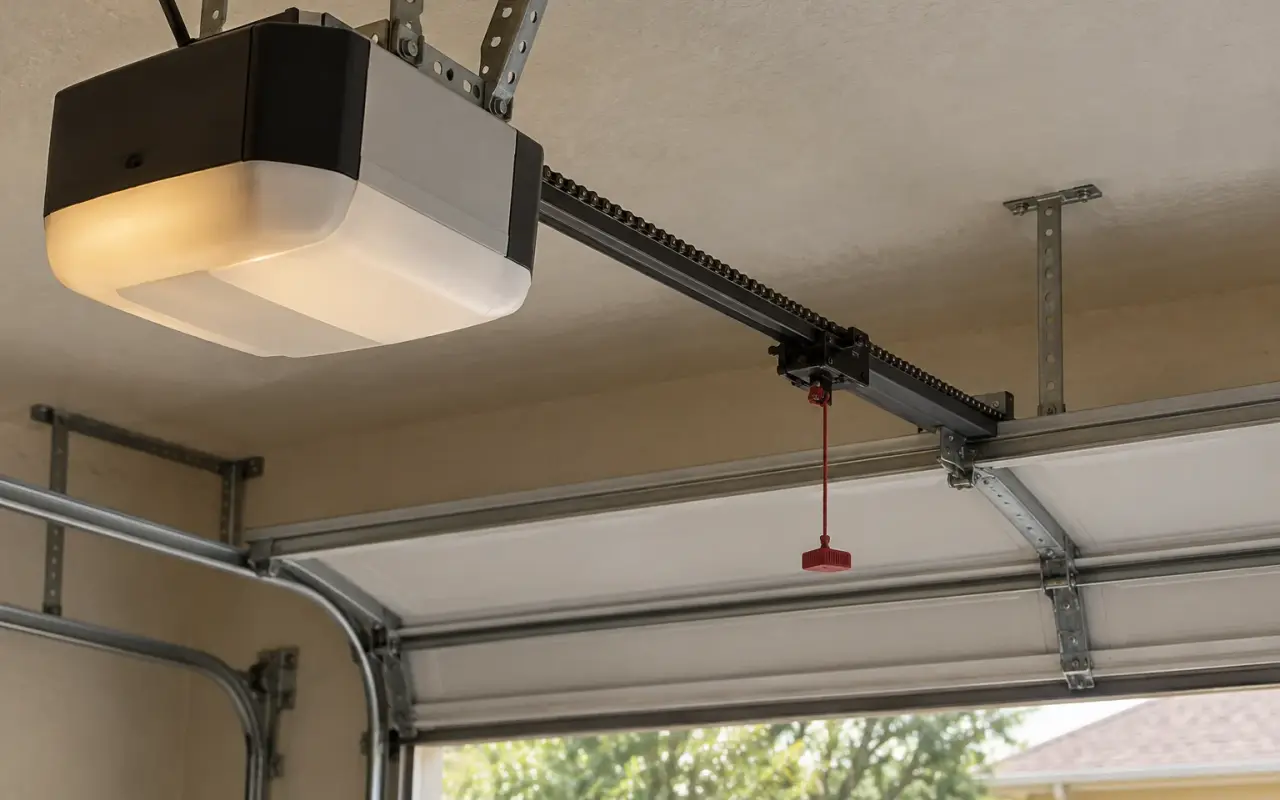
The opener is the part of a garage door that is easiest to misread. It does not lift the door's weight; the springs do. It moves a balanced door, and it is required by federal rule to stop and reverse when the door meets something.
Motor running, door not moving
The door is disconnected. A cord, usually with a red handle, hangs from the carriage on the opener's rail. Pulled, it frees the door from the opener. Watch the carriage while the motor runs: if it travels and the door stays, the door is disconnected, and the manual explains how to reconnect it. Do that only if the springs are whole, and with the door closed where you can: the federal manual text says to use the release "only when the door is closed" where possible.
A spring is broken. The opener tries, the door rises a few inches or not at all, and the motor stops. Look for a gap in the coil. See broken spring.
The opener has failed. Springs whole, door connected, not locked or stuck to the floor, and the motor hums without the chain or belt moving: the fault is most likely inside the opener.
The reverse test
Federal rules require every residential opener's manual to carry this instruction:
Test door opener monthly. The garage door MUST reverse on contact with a 1½ inch object (or a 2 by 4 board laid flat) on the floor.
— 16 CFR 1211.16(b)(2)
Lay a piece of 2-by-4 flat on the floor in the middle of the opening and close the door. It must stop and go back up; the rule's standard is that reversal begins "within 2 seconds of contact with the obstruction" (16 CFR 1211.7(b)(1)(i)). Keep children and pets out of the garage while you test.
If it does not reverse, the Consumer Product Safety Commission's instruction is that the opener "should be disengaged until the unit is either adjusted …, repaired, or replaced" (CPSC Pub. 523). Disengage it with the door closed and the springs whole, then call.
When an opener is too old to keep
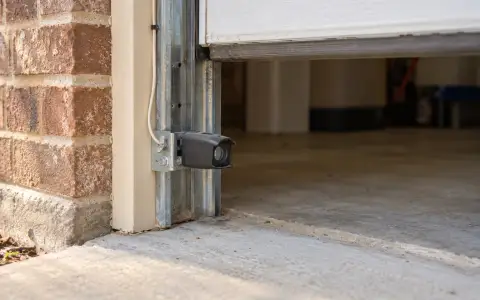
Openers made for sale after January 1, 1991 have had to reverse on contact; a second, external protection, usually the two sensors near the floor, was required from 1993 (CPSC Pub. 523). The federal standard applies to openers manufactured on or after January 1, 1993 (16 CFR 1211.1). An opener with no sensors near the floor may be older than both. Where half the houses predate 1993, an original opener is worth looking for; each place page says when half its housing was built.
Buying a new one
- Check the door first. A new opener on a door with a weak spring strains like the old one did.
- Closing from an app or on a timer is not allowed on every door: "Unattended operation shall not be permitted on one-piece garage doors or swinging garage doors" (16 CFR 1211.14(a)(2)). If your door tilts up in one piece, say so on the call.
- Run the reverse test with the technician before they leave.
Updated 2026-09-30.
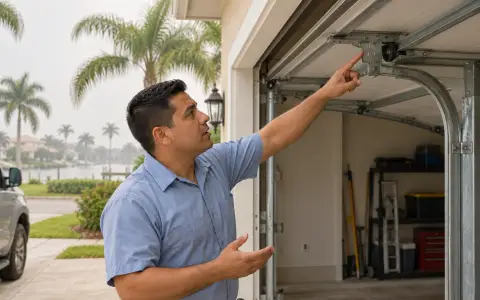
 Windstorm inspection
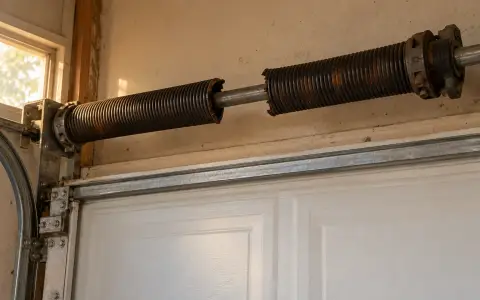 Broken spring
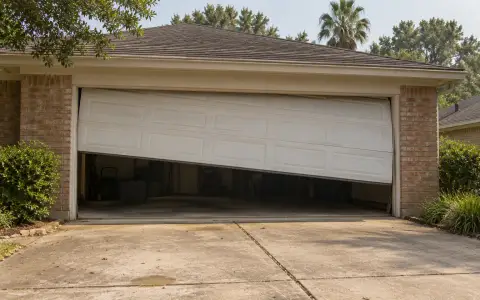 Crooked or off track
 Won't open
 Won't close
 Car hit the door
 Door replacement
 Before you call